Ship 100 kg of cotton and 100 kg of iron and you will pay very different prices because carriers don’t charge only by weight; they charge by the space a parcel occupies.
That is volumetric weight. This guide explains what it is, the exact formula (with carrier divisors), how it changes your shipping cost, and how to pack smarter to pay less.
What is the Actual Weight of the Shipment?
Actual weight (also called physical or dead weight) is simply what the parcel weighs on a scale, in kilograms. It is measured after packing, using calibrated scales.
What Is Volumetric Weight?
Volumetric weight (also called dimensional weight) is a pricing measure that converts a parcel’s dimensions length × width × height) into an equivalent weight.
It represents the space the shipment occupies in a truck or aircraft. Carriers compare it against the actual weight and charge for whichever is higher; the greater of the two is called the chargeable weight.
Volumetric Weight vs. Actual Weight
Actual weight | Volumetric weight | |
|---|---|---|
What it measures | Physical mass of the parcel | Space the parcel occupies |
How it’s determined | Calibrated scale, after packing | Formula: (L × W × H) ÷ carrier divisor |
When it sets the price | When it is higher than volumetric weight | When it is higher than actual weight (light, bulky parcels) |
In reality, there are some subtle differences between the volumetric weight and the actual weight of parcels, and we can summarize these differences in several points:
The actual weight represents the real weight of the parcels, which is known through approved scales, while the volumetric weight expresses the space the shipments will occupy according to their dimensions inside the various means of transport.
The volumetric weight of the shipment is known through the use of certain mathematical formulas, while the actual weight is known after packing and packaging the shipment by placing it on an approved digital scale.
Shipping cost is determined by specialized companies based on the density of the shipment in volumetric weight, while it is determined by kilograms in actual weight.
Did you know that the actual weight of the shipment is completely different from the volumetric weight, and that the actual weight is not the only factor affecting the shipping cost calculation?
The example of cotton and iron is always used to differentiate between the terms volumetric weight and actual weight.
If we compare a shipment with an actual weight of 100 kilograms of cotton and a shipment with an actual weight of 100 kilograms of iron, certainly both shipments have the same actual weight, but the volumetric weight of each is different from the other, as the volume of cotton will be much larger than the volume of iron.
In this article, we will discuss the concept of volumetric weight in shipping and how to calculate it, the reason for the increase in volumetric weight of parcels and shipments, and the differences between it and actual weight.
What is the Actual Weight of the Shipment?
It is simply the real or physical weight of the shipment, and it means the amount of its weight in kilograms or other weights used by shipping companies.
Therefore, it is easy to determine the actual weight because it is a direct measure of the mass of the shipment body, and it is calculated based on approved shipping weights using specialized scales to measure the shipment weight.
What is Volumetric Weight in Shipping?
Volumetric weight in the field of shipping is related to the dimensions of the shipment or parcel, and it expresses the way in which the amount of space the shipment will occupy on the various means of transport used in the shipping process, whether these means are land, sea, or air, is measured.
We would like to point out that volumetric weight is also called Dimensional Weight and is no less important than the actual weight of parcels, as shipping companies need to know both weights to calculate shipping costs for shipments accurately.
What is the Difference Between Volumetric Weight and Actual Weight?
In reality, there are some subtle differences between the volumetric weight and the actual weight of parcels, and we can summarize these differences in several points:
The actual weight represents the real weight of the parcels, which is known through approved scales, while the volumetric weight expresses the space the shipments will occupy according to their dimensions inside the various means of transport.
The volumetric weight of the shipment is known through the use of certain mathematical formulas, while the actual weight is known after packing and packaging the shipment by placing it on an approved digital scale.
Shipping cost is determined by specialized companies based on the density of the shipment in volumetric weight, while it is determined by kilograms in actual weight.
The question now is, when is the actual weight used instead of the volumetric weight when calculating shipping cost?
The actual weight is usually used if the volumetric weight is less than the actual weight of the shipment, so that shipping fees are applied based on the actual weight in this case.
The Relationship Between Volumetric Weight and Shipping Cost
Shipping cost is directly related to the volumetric weight of shipments. In the past, logistics companies calculated shipping costs based on the actual (real) weight of the shipment, but it was noted that some light shipments occupy a large space inside the means of transport used in the shipping process, which may force them to reduce the number of shipments transported at one time due to consuming a large space of the means of transport.
For this reason, companies invented an additional measure, which is the "volumetric weight," to rely on when calculating shipping cost. It is worth noting that shipping cost increases with the increase in the volumetric weight of shipments, and the reason for this is that shipments with a large volumetric weight consume more space inside the means of transport, which reduces the total number of shipments that can be shipped via the used means of transport.
Logistics companies usually rely on calculating shipping cost based on the real or actual weight of the parcels, but they use the volumetric weight if it is greater than the actual weight of the shipment to provide a fair cost.
How to Calculate the Volumetric Weight of a Shipping Package?
The volumetric weight of the shipment or parcel is calculated by multiplying the length of the shipment × its width × its height, then dividing the result by the volumetric conversion factor (DIM).
⚠️ Please note that the volumetric factor may differ from one shipping company to another, but the majority of shipping companies rely on the number 4000 as a standard volumetric factor for land shipments, and 6000 for air shipments.
Here is an illustrative example: suppose you have a shipment with a length of 50 cm, a width of 40 cm, and a height of 30 cm, and you want to ship it by land. So the volumetric weight of this shipment is the result of: 50 × 40 × 30 / 4000 = 15
So the volumetric weight of this shipment is 15 kg
Do you want an easier way to calculate the shipping price taking into account the volumetric and actual weight of the shipment?
Well, at Oto, we provide our customers with a shipping price calculator through which you can enter the shipment data, dimensions, and weight to calculate the shipping price taking into account all the factors affecting the shipping price, including the volumetric weight.
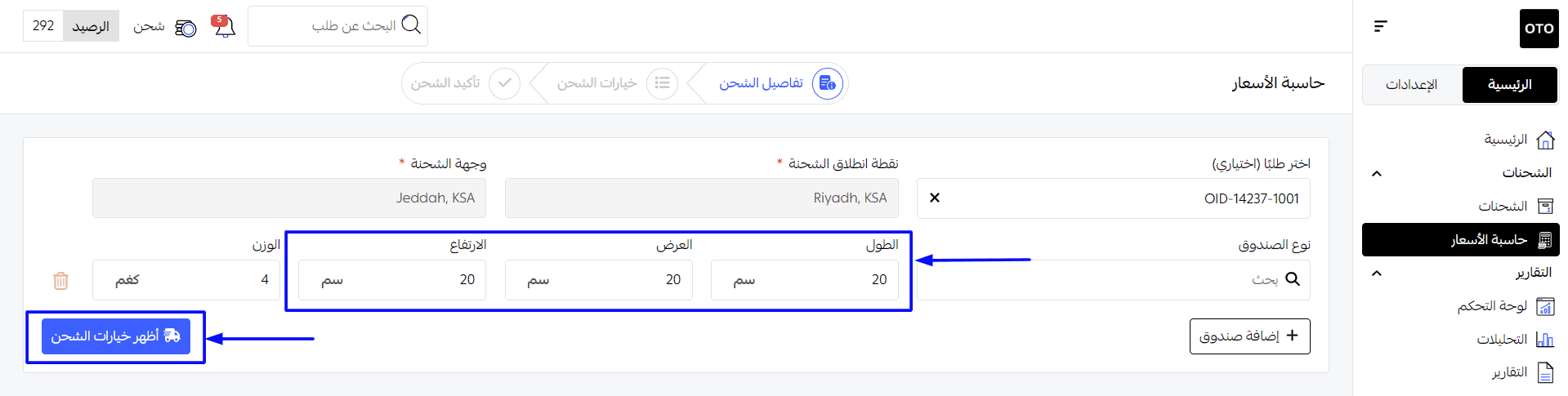
After entering all the necessary data and clicking the Show Shipping Options button, the different shipping alternatives available in Oto will appear based on the data you entered and according to the actual weight and volumetric weight of the shipment, as shown in the screenshot below 👇
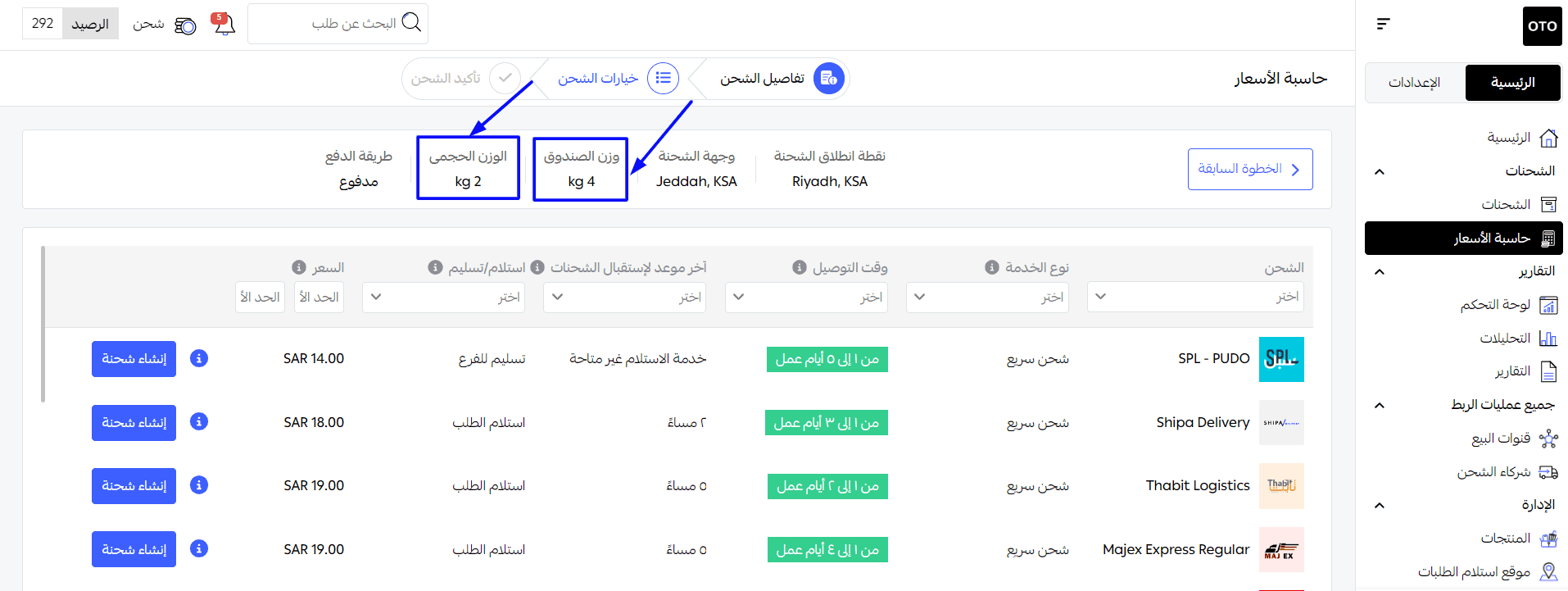
You can now create a free account in Oto and use the price calculator freely and completely free of charge and benefit from the multiple shipping options offered by Oto, and customized shipping solutions that suit all businesses of different sizes and needs.
⚠️ Important Note:
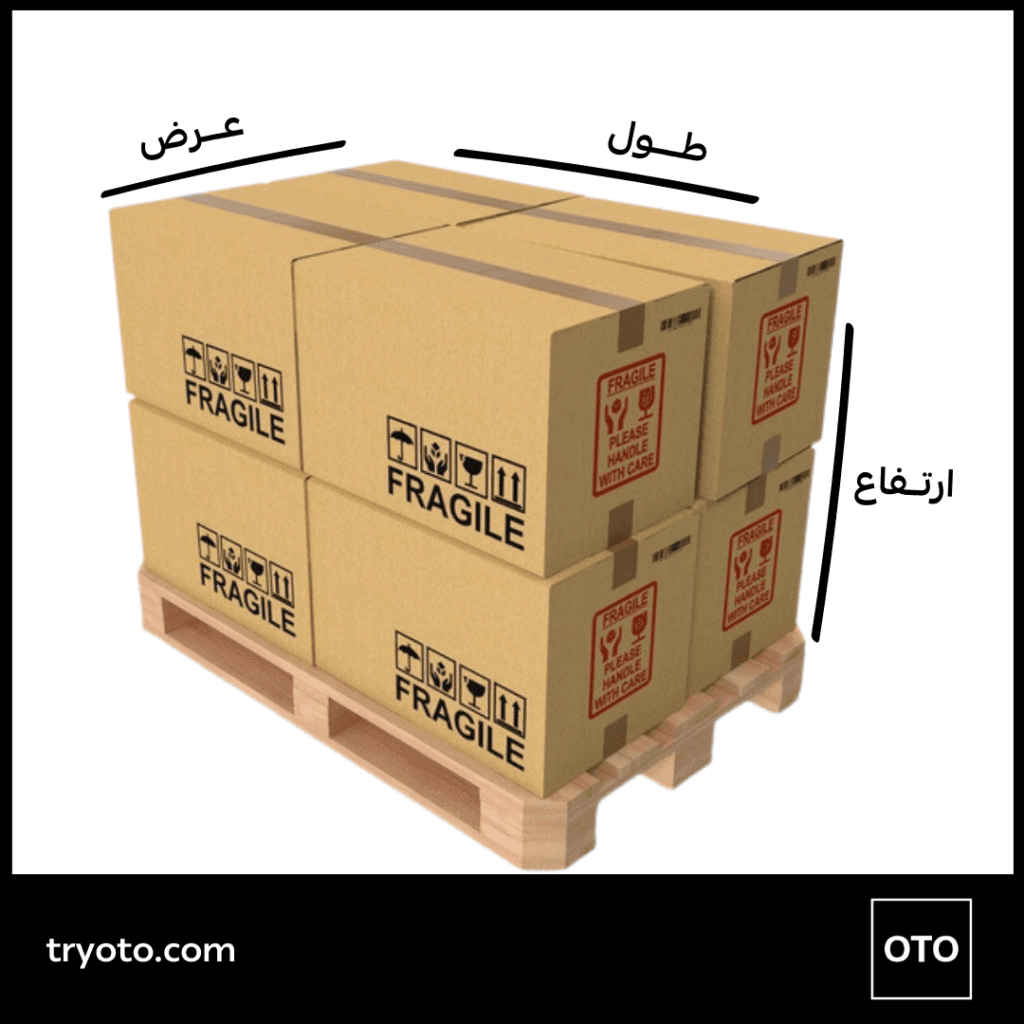
If the shipment contains more than one box, the volumetric weight is calculated based on the sum of the dimensions of all the boxes, and not on the basis of each box individually, meaning calculating the dimensions of all boxes with one equation, where all dimensions are measured and summed together as shown in the following image:
Reason for Volumetric Weight Increase and How to Reduce It
As we mentioned earlier, an increase in the volumetric weight of parcels means an increase in shipping cost, but what is the reason behind this increase?
Well, the reason behind the increase in the volumetric weight of your shipments is the method used in the packing and packaging process. The method followed may be wrong and does not fit the nature of the products being packed for shipment. For example, you may use very large boxes and the products inside only occupy a small space, which increases the shipping cost unnecessarily.
To overcome this problem and reduce shipping cost, it is necessary to pack and package shipments professionally according to a scientific method that guarantees you to reduce shipping costs and deliver parcels safely and with the best possible quality.
To reduce the volumetric weight of your shipments, you can:
Choose the smallest possible package that fits each item inside the parcel so that it does not occupy a large space, and avoid choosing large boxes to pack your shipments to reduce the dimensions of the parcel and thus occupy less space inside the means of transport and consequently reduce shipping costs.
Balance between low-density items and high-density items and combine them inside your parcel to ensure the creation of a balanced shipment in terms of weight and dimensions.
Net Weight vs. Gross Weight
Net weight is the weight of the goods alone, before packaging.
Gross weight is the total weight of the shipment ready for transport: goods plus all packaging (box, filler, pallet). Net weight is fixed for a given product; gross weight varies with how the shipment is packed.
Frequently Asked Questions
What unit is volumetric weight expressed in?
Kilograms. The formula converts cubic centimeters of volume into a kilogram-equivalent so it can be compared directly with actual weight.
What affects volumetric weight?
Only the parcel’s external dimensions length, width, and height- measured on the closed, ready-to-ship box. The bigger the box, the higher the volumetric weight, regardless of what is inside.
What is chargeable weight?
The weight the carrier actually bills: the higher of actual weight and volumetric weight.
How do I measure my parcel’s dimensions?
Measure length, width, and height in centimeters from the outer edges of the sealed box, ready for shipping. Round up to the nearest centimeter carriers do.
Conclusion
Volumetric weight is how carriers charge for space, and it is one of the few shipping costs fully under your control: smarter packaging directly cuts what you pay.
Measure honestly, pack tight, and compare carriers; divisors differ, so the same parcel can be priced very differently across companies. Use the OTO price calculator to see your real chargeable weight and price across 200+ carriers before you ship.

إيهاب محمود