What is the secret behind the prosperity and continued success and profitability of some commercial activities and the decline of others?
The secret lies in the Profit Margin, which is the compass that guides business owners on their journey towards profit or loss, as it represents the true indicator of the efficiency of commercial operations and the effectiveness of the strategies followed.
If the profit margin is high, it indicates that the commercial activity enjoys high efficiency in managing operations, improving production and manufacturing processes, reducing costs, and increasing revenues through improving marketing and sales strategies. If the profit margin is low, this is an indicator of weak efficiency in managing commercial operations and consequently a decline in net profit and incurring losses.
Let's explore the meaning of the term profit margin, learn about its types, how to calculate it, and how to work on improving it to achieve the maximum possible returns on investment.
What is the profit margin and what are its most important benefits for commercial activities?
Simply put, it is a term that refers to the difference between the selling price of the product or service and its cost, in other words, the difference between sales revenue and the cost of production or purchase. It expresses the money remaining after deducting the company's startup expenses as a percentage that measures the profitability of the pricing strategy, the efficiency of cost control, the use of raw materials and the employment of labor to produce products or services, and thus the ability to achieve profits and compete in the market.
The most important benefits of tracking the profit margin:
Measuring operational efficiency:
The profit margin enables business owners to evaluate the efficiency of resource use in production or service delivery, as a high profit margin indicates efficient use of resources, while a low profit margin indicates gaps in the administrative efficiency of resources that require treatment.
Evaluating the effectiveness of strategies:
The profit margin helps evaluate the effectiveness of pricing, marketing, and production strategies. An increase in the profit margin indicates the success of the strategies followed, while decreases indicate the need to review and adjust those strategies.
Making strategic decisions:
The profit margin provides valuable information to decision-makers to make informed decisions based on available data to identify the most profitable products or services, better allocate resources, and set competitive prices.
Comparing performance:
The profit margin can be used to compare the company's performance over different time periods, or to compare its performance with that of competing companies to identify strengths and weaknesses and continuously improve performance.
Attracting investors:
The profit margin is an important indicator of the brand's attractiveness to investors, as a high net profit reflects the company's ability to generate sustainable profits, which reduces risks for investors and strengthens confidence in its ability to grow and achieve more profits in the future.
Types of Profit Margin and How to Calculate Them
There are three main types of profit margins:
First: Gross Profit Margin
It refers to the percentage of gross profit compared to total revenues. It is one of the most important metrics used to measure the profitability of commercial activities and determine the company's efficiency in converting its revenues into profit before calculating other expenses such as operating expenses and taxes.
How can you calculate the gross profit margin?
Gross Profit Margin = (Sales Revenue – Cost of Goods Sold) ÷ Sales Revenue × 100
For example, if the commercial activity's sales revenue is 1,000 riyals, and the cost of goods sold is 600 riyals, the gross profit margin will be (1,000 – 600) ÷ 1,000 × 100 = 40%.
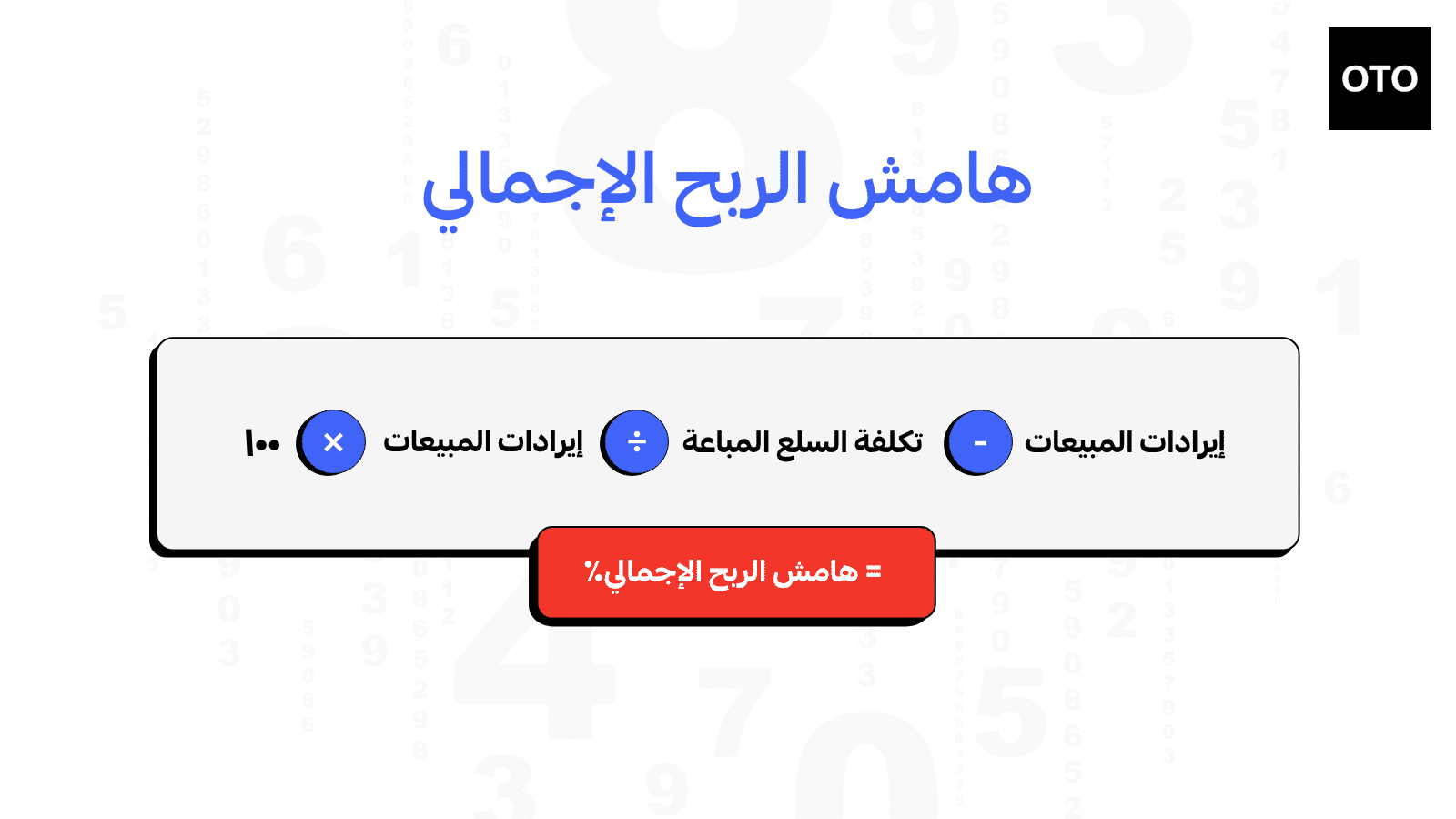
The importance of the gross profit margin is that it:
Is a key indicator for measuring profitability, as a high gross profit margin indicates the brand's effectiveness in managing its costs and converting its revenues into profit. While a low gross profit margin expresses facing difficulties in covering costs due to a management defect resulting from weak efficiency or the inefficiency of the product itself or other reasons.
Compares the company's performance continuously over different time periods, in addition to comparing its performance with the performance of other companies in the same industry to identify strengths and weaknesses and continuously work on improvement to achieve higher gross profit margins.
Determines the cost of products or services offered and then uses the extracted information to improve cost management and make strategic decisions based on actual data.
There are many factors that affect the gross profit margin, including:
Product selling prices: The higher the selling prices, the higher the gross profit margin.
Cost of goods sold: The lower the cost, the higher the gross profit margin.
Production efficiency: If the company is more efficient in production, this contributes to a lower cost of goods sold and a higher gross profit margin.
Tracking this important indicator is useful in:
Improving budget planning, setting financial goals, making financing decisions, and determining future investments.
Determining optimal pricing strategies for products and services offered and adjusting prices to achieve a higher gross profit margin or increase market share through competitive pricing.
Improving operational efficiency by identifying weaknesses and working to improve them. For example, the cost of sales can be analyzed and the factors affecting the gross profit margin can be identified, which helps in taking actions to reduce costs and improve operations.
Evaluating the performance of different products and services offered by the commercial activity by analyzing the performance of each product or service separately and determining the most and least profitable, which helps in making decisions about focusing on products with the highest return.
Second: Operating Profit Margin
This type of profit margin measures the amount of profit that commercial activities achieve from every riyal earned from sales after paying variable production costs such as employee wages, raw materials, daily expenses necessary to run the business, depreciation expenses, and so on. The operating profit margin does not include non-operating expenses such as interest or taxes.
How can you calculate the operating profit margin?
To calculate the operating profit margin, we use the following equation:
Operating Profit Margin = (Sales Revenue – Operating Costs including wages and taxes) ÷ Sales Revenue × 100

The operating profit margin is affected by many factors, including:
High cost of raw materials and production costs leading to a decrease in the operating profit margin, as it reduces the profit realized from each unit produced or service sold.
Increase in operating costs, including labor costs, energy, maintenance, insurance, rents, taxes, and other general and administrative costs, which leads to a reduction in the operating profit margin.
Competitiveness and market strength in some industries where competition is fierce, requiring price reductions to maintain market share and consequently lower profitability.
Many commercial activities rely on a variety of strategies used to improve the operating profit margin, including, for example:
Increasing revenues by selling more products or services, or selling them at higher prices.
Reducing the cost of goods sold by negotiating better prices with suppliers, or improving the efficiency of production operations.
Reducing operating expenses by controlling administrative expenses, restructuring operations, or utilizing innovative technologies to reduce costs.
Improving collection processes by reducing the time it takes to collect debts from customers.
Third: Net Profit Margin
Net profit refers to the revenue remaining after deducting all costs and expenses, including the cost of goods sold, operating expenses, interest, and taxes. The net profit margin reflects the percentage of net profit compared to the company's total revenue, and this indicator is very important, as it helps investors and shareholders evaluate the company's performance and its ability to achieve profitable returns.
How can you calculate the net profit margin?
To calculate the net profit margin, we use the following equation:
Net Profit Margin = (Sales Revenue – Total Production Costs and Operating Costs) ÷ Sales Revenue × 100

The most important factors affecting the net profit margin include:
Cost of goods sold, including the cost of raw materials, labor, and other inputs used in producing goods or services.
Operating expenses, including employee salaries, rent, marketing, and other administrative expenses.
The pricing strategy followed for products.
Sales volume.
Taxes, loan interest, and other financial burdens.
How to improve the profit margin for your online store?
To improve the profit margin for your online store, you can follow some of the following strategies:
Reviewing the cost structure of your products
By analyzing it comprehensively to try to reduce costs in areas where expenses are high without compromising product quality or customer service. For example, you can negotiate with suppliers for better terms or improve production and distribution processes to save more costs and thus succeed in improving the profit margin.
Increasing prices
There may be an opportunity to increase the prices of your products based on market analysis, the nature of the competition, and the value of the product, but before adopting this strategy, the reactions of potential customers should be tested and a price increase should be tried on a specific category of products to measure its impact on your sales.
Improving sales traffic
By analyzing it accurately and identifying areas that can be improved, including, for example: improving the website design and user experience, simplifying the purchase and payment process, and improving customer service to increase the conversion rate and loyalty.
Providing added value to consumers
To justify price increases or to attract new customers, you can offer free shipping and delivery services, free gifts with purchase, or loyalty programs that give customers points or discounts. In this context, we point out that OTO, the leading shipping gateway in the Arab world, allows you to link your contracts with more than 200 local and international shipping companies and ship at your own prices or benefit from OTO's discounted shipping prices that have been negotiated with shipping companies in advance to ship at the lowest cost and highest efficiency. Create a free account in OTO and try now.
Launching strong and effective advertising campaigns
To increase brand awareness and the products and services it offers by using various digital channels such as social media, email, and paid advertisements to reach a wider audience and increase traffic and sales.
Expanding the scope of commercial activity
To include various products and target different markets based on market needs analysis and customer trends, and exploring products or services that you can add to your online store to meet those needs, increase revenues, and diversify sources of profit.
Analyzing sales data
To understand patterns, trends, and the most profitable products, and then use this information to identify profitable categories, focus on marketing them better, and improve your supplies and inventory plans.
Know that improving the profit margin requires a combination of different strategies and continuous experimentation according to a scientific approach to modify ideas according to the unique circumstances of your store, the nature of the target market, and consumers, which contributes to achieving the goals you seek.
The most common questions about profit margin
Due to the breadth of topics related to the profit margin, we saw fit to prepare this section that includes some frequently asked questions in an attempt to cover various aspects.
What is the difference between profit and profit margin?
Simply put, profit is the amount remaining after deducting all costs from revenues and is measured in currency, whether dollar, riyal, or pound. While the profit margin expresses the percentage of profit compared to total revenues, and is used to measure the company's efficiency in converting revenues into profits. Profit represents the actual amount, while the profit margin represents the percentage of that amount.
Is the contribution margin the profit margin?
No, they both differ from each other as follows:
Contribution Margin:
It refers to the difference between sales revenue and variable cost of sales, and is used to calculate the extent to which a product or service can cover fixed costs and achieve profits, so it is an important indicator for evaluating the company's operational efficiency.
Profit Margin:
It refers to the percentage of net profit in relation to total revenues, and is usually calculated by dividing the net profit by the total revenues and multiplying it by one hundred, and the profit margin reflects the company's ability to achieve profits from its operations after deducting all costs and expenses.
In short, the contribution margin is related to the cost of sales and revenues, while the profit margin is related to net profit and revenues.
What is a good profit margin percentage in trade?
The usual profit margin percentage in trade varies between different industries and sectors, and also depends on many factors such as the type of products or services the company sells, its size, the nature of market competition, general economic conditions, and other factors.
In general, some industries, such as the retail and restaurant sector, have relatively low profit margins, usually ranging from 2% to 8%. In industries that require high capital investments and high production costs, such as heavy industries or technology industries, they may have higher profit margins, usually ranging from 10% to 20% or more.
Conclusion
The profit margin is the pulse of trade. The higher it is, the more it expresses administrative efficiency, and consequently financial stability and continued competition. The lower it is, the more difficult it is to stay in the market. Therefore, it is necessary to:
Measure your profits: Be sure to calculate the profit margin accurately to know the profitability of each product or service, as this will help you make smart decisions regarding pricing, discounts, and promotional offers.
Improve the profit margin: Look for ways to reduce costs such as negotiating with suppliers, finding cheaper alternatives for raw materials, or reducing operating expenses.
Strategic pricing: Set competitive prices taking into account the cost of production and the target profit margin.
Diversify products and services: Offer a variety of products and services with a high profit margin.
Effective marketing: Invest in types of e-marketing to attract more customers and increase sales.
Know that the profit margin is the result of your decisions and actions, so be keen to monitor the profit margin and take steps to improve it continuously to enhance competitive value and achieve the maximum possible returns on investment.

إيهاب محمود