Affiliate Marketing has gained widespread fame in the digital age as one of the most effective marketing strategies. It is a unique model of digital marketing that relies on paying a commission to individuals who promote products or services to achieve the desired goals.
The success of affiliate marketing depends on the cooperative relationship between the seller and the partner (the marketer), where a commission is paid for every successful sale or marketing operation achieved through the marketer's efforts. This way, the marketer has a strong incentive to work hard and focus on marketing the product or service in the best possible way to achieve greater profits.
The idea of affiliate marketing is based on encouraging individuals to promote products or services by giving them a financial incentive, which can be a percentage of the sales value or a fixed amount for each specific sale upon completion of the transaction.
It is also an effective way for companies and service providers to increase profits and enhance competitive value in the market at a low cost compared to other marketing methods, while providing marketers with the opportunity to earn extra money and increase their income according to their ability to achieve sales.
Let's explore the concept of affiliate marketing, its types, and the difference between it and referral marketing.
Explanation of the Idea of Affiliate Marketing
As we mentioned earlier, affiliate marketing is a unique and strategic marketing model that relies on an implicit partnership between commercial activities or service providers and external marketers to boost the sales of products and services.
This unique marketing model aims to overcome many of the challenges in achieving growth and increasing sales for various brands resulting from weak marketing strategies despite the quality of the products or services offered, by utilizing the capabilities of external marketers who possess huge audience bases, but do not own the distinctive products they can promote.
Thus, affiliate marketing comes as an innovative type of types of electronic marketing to bridge this gap, allowing marketers the opportunity to promote company products in exchange for a pre-determined commission, which enhances the chances of increasing revenues and achieving marketing goals effectively.
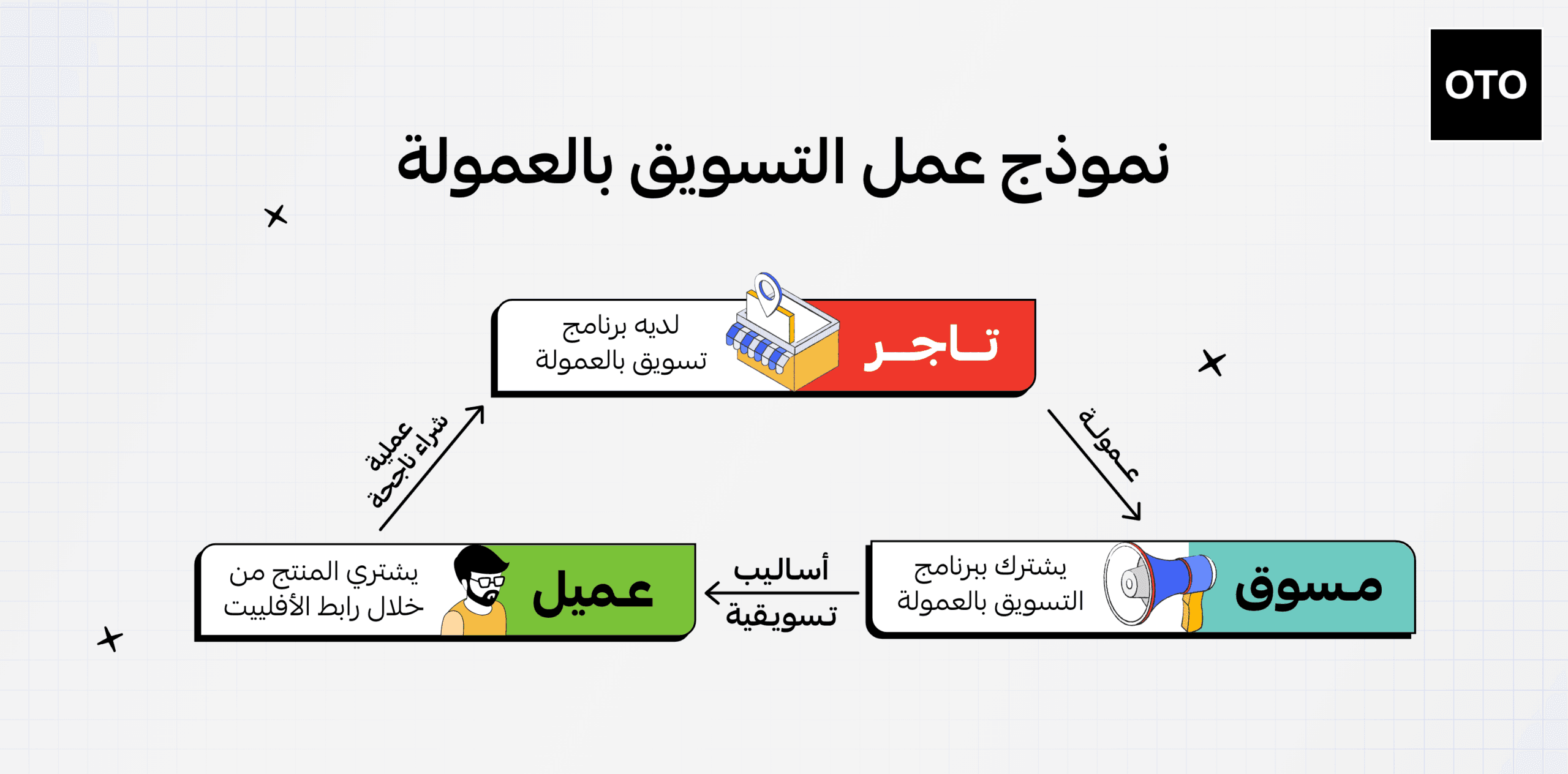
هذه ببساطة فكرة التسويق بالعمولة كاستراتيجية من استراتيجيات التسويقThis is simply the idea of affiliate marketing as a strategy of the followed e-marketing strategies, which differs slightly from the referral marketing strategy.
Key Differences Between Affiliate Marketing and Referral Marketing
The main differences and distinctions between Affiliate Marketing and Referral Marketing are summarized in:
Focus Scope:
Affiliate marketing focuses on reaching new customers through cooperation with external marketers who promote your products or services in exchange for a commission on every sale. While referral marketing focuses on motivating current customers to recommend what you offer of products or services to their circle of friends and acquaintances in exchange for rewards.
Target Audience:
Affiliate marketing targets a wide and diverse audience in terms of social segments through external marketer networks who have a large audience base. While referral marketing targets a specific audience of friends and acquaintances of current customers who are likely to trust their recommendations.
Relationship:
Affiliate marketing relies on contractual relationships between advertisers and external marketers that define the terms of cooperation and agreement on the nature of the commission paid. While referral marketing relies on personal relationships and mutual trust between current customers and their friends and acquaintances.
Result:
Affiliate marketing achieves effective and short-term results by reaching new customers and thus increasing sales, while referral marketing achieves long-term results in building loyalty and increasing the customer base.
In general, both strategies have their own benefits and uses, and they are employed according to the type of product or service provided and the desired results to be achieved.
It is worth noting that Oto, the leading shipping gateway in the Arab world, has an innovative referral program that allows its customers to get rewards by sharing their special invitation link to invite their friends to use Oto and get free credit used to ship customer orders for free.
Types of Affiliate Marketing
The famous marketer Pat Flynn divided the types of affiliate marketing into 3 main types:
Unattached Affiliate Marketing:
It is an affiliate marketing model in which products or services are promoted in whose field the marketer has no experience, relationship, or authority. They cooperate with advertisers from different fields than their specialization, using their marketing skills to attract new customers to the product or service in exchange for a specified commission.
Related Affiliate Marketing:
This is the opposite of the previous type, where products or services are promoted in whose field the marketer has experience, relationship, or authority, relying on their capabilities, skills, and existing audience base to achieve the desired marketing goals and obtain the agreed-upon commission.
Involved Affiliate Marketing:
It is a type of affiliate marketing that combines the features of unattached and related affiliate marketing. In this model, the marketer promotes products or services in whose field they have some experience, relationship, or authority, but do not have extensive experience like marketers in the related affiliate marketing model.
We note that there are basic stages that commercial activities and service providers go through when implementing the affiliate marketing strategy, which we explain in this paragraph.
Stages of Implementing Affiliate Marketing for Different Commercial Activities
First: The Partnership Formation Stage
In this stage, online stores and service providers display their affiliate marketing programs and offers through various digital channels so that marketers choose the programs that suit them according to their areas of interest and the products they wish to market, then they join these programs to achieve the desired goals and increase profitability. To form successful partnerships with external marketers, it is essential to:
Define the goals to be achieved through the affiliate marketing strategy, including increasing sales, brand awareness, attracting new customers, etc.
Carefully choose external marketers who have an audience base compatible with the products or services of the online store or service provider.
Provide all the information external marketers need to understand your products or services and your target audience, while ensuring fair and competitive offers regarding the commission.
Effectively communicate with external marketers, provide support to them, answer their questions, and solve any problems they may face that affect the achievement of the desired goals.
Regularly measure results to identify strengths and weaknesses regarding the affiliate marketing strategy and work to improve it and make necessary adjustments.
Second: The Stage of Obtaining Affiliate Links
When a marketer joins any affiliate marketing program affiliated with any of the various commercial activities, they are given unique tracking links or codes for each product or service they will promote. These links enable online stores and service providers to accurately track traffic and sales, to identify the marketer who contributed to the completion of purchases and then determine the agreed-upon commission with transparency and fairness.
Third: Directing Customers to Advertisers' Websites
In this stage, the target audience is directed to click on the affiliate link to move to the advertiser's website (online store or service provider) to complete the purchase easily and quickly, which helps in improving the user experience and increasing sales. You can use these tips to achieve full benefit from this type of links for the commercial activity:
Make sure the affiliate link title is attractive and encourages the target audience to click on it.
Clarify to the user what they will get when clicking on the link.
Use high-quality images that attract the attention of the target audience and arouse their curiosity.
Rely on data analysis tools to track results and know the number of clicks on the affiliate link and the number of conversions made.
Strategic Recommendations for Benefiting from Affiliate Marketing
Choose external marketers who have a good reputation in the market and ensure their skills in the field to guarantee the effective promotion of your products or services and achieve the desired goals.
Provide your external marketing partners with effective marketing tools such as customized referral links and innovative promotional materials. They must have effective means to attract customers and encourage them to purchase.
Be sure to offer incentive offers that encourage external marketers to exert their utmost effort to promote what you offer of products or services.
Be creative in affiliate marketing strategies and look for new opportunities for promotion and increasing sales by encouraging external marketers to try new ideas and continuously improve existing operations.
Study the affiliate marketing strategies used by your competitors and analyze their performance, and use this information to improve and develop your strategy to give you a competitive advantage.
Use data analysis tools to track the performance of external marketers and measure the effectiveness of marketing campaigns, and rely on the extracted data to improve performance and enhance results.
Key Advantages of Affiliate Marketing for Commercial Activities
The advantages of affiliate marketing for different commercial activities, whether online stores or service providers, include:
Control over Marketing Expenses:
The affiliate marketing model is considered effective because it allows the company to control marketing expenses, as the commission is paid to marketers only when tangible results are achieved, which reduces the risks associated with spending on ineffective or unsuccessful marketing campaigns and ensures motivating marketers and improving their performance, thus achieving high-quality results that guarantee an increase in the return on investment.
Precise Targeting:
Affiliate marketing enables stores and service providers to partner with marketers who have an audience base interested in a specific field, which helps in precisely targeting consumer segments. This precise targeting ensures that promotional efforts reach the appropriate segments, leading to high conversion rates and increased sales.
Opening New Horizons:
Affiliate marketing helps brands of all kinds to enter new markets and expand the scope of their operations, benefiting from the network of marketers to reach new customers in unfamiliar regions or markets for them, which contributes to increasing the targeted area and thus enhancing growth and increasing profits.
Diversity of Marketing Channels:
Marketers use diverse promotional channels, including blogs, social media, email campaigns, podcasts, and more, to market products or services. This diversity in channels allows commercial activities and service providers to benefit from various platforms to enhance their communication and interaction with the target audience across their various social segments and achieve the desired goals.
Real-Time Tracking and Analysis Capability:
Affiliate marketing platforms and programs allow real-time tracking and analysis of transactions, which allows monitoring the performance of each marketer, tracking conversion rates, measuring the results of marketing campaigns, and evaluating their success. This data-driven approach enables online stores and service providers to make informed and accurate decisions to improve their promotional strategies and develop their performance to achieve the highest possible return on investment.
Final Word
Implementing affiliate marketing as an innovative e-marketing strategy requires meticulous planning and a comprehensive study from all aspects to ensure the achievement of the maximum possible returns on investment. With the increasing popularity of affiliate marketing, competition in this field is increasing, making it essential to keep pace with the latest trends and technologies. Therefore, we recommend you follow the following tips to ensure maximum benefit from this effective strategy:
Follow the latest trends in affiliate marketing, and be prepared to adapt to changes and keep up with them to stand out among competitors.
Use data analysis tools to better understand the performance of your marketing campaigns.
Build strong relationships with your external marketers, and support them in achieving their goals and the goals of your brand.
Finally, we point out that affiliate marketing is a long-term investment, so do not expect immediate results. Therefore, you must be patient to reap the fruits of your efforts in the end.

إيهاب محمود