Whether you run an online store, a shipping company, or any service business, your customers judge you on one thing: did you deliver what you promised? A Service Level Agreement (SLA) turns that promise into a measurable, enforceable commitment.
In this guide, you will learn what an SLA is, the main types, the elements every agreement should include, and the KPIs with 2026 benchmarks that tell you whether your logistics partner is actually performing.
Let's follow along...
What is a Service-Level Agreement (SLA)?
A Service Level Agreement (SLA) is a contract between a service provider (for example, a shipping company) and a client (for example, a merchant or brand) that defines the services to be delivered, the performance standards they must meet, and the remedies that apply when those standards are missed.
In logistics, an SLA typically covers delivery times, order accuracy, tracking updates, reporting, and compensation for lost or damaged shipments. If you run an online store and contract a courier, the SLA is what guarantees in writing that "delivery within 48 hours" is a commitment, not a marketing slogan.
For example, you have an online store through which you sell some products, and you certainly need a shipping company to deliver these products.
To ensure your rights with the shipping company, you will need to sign an agreement with the shipping company that includes the logistics services you will benefit from, regular reports and reviews, as well as quality standards or performance metrics for these services in exchange for the price you will pay, all of which is agreed upon by both parties.
Why Businesses Use SLAs?
There are many reasons that drive institutions to implement a Service Level Agreement, including:
Set clear expectations
Both sides know exactly what "good service" means. If the merchant expects 24-hour delivery and the courier plans for 72 hours, the SLA surfaces that mismatch before it costs you, the customers.
For example, if the customer expects delivery within 24 hours while the service provider plans to deliver within 72 hours, this may lead to customer dissatisfaction. By implementing an SLA, standards are clearly set from the beginning, which reduces the likelihood of disputes and helps build a more transparent and stable relationship between the two parties.
Guarantee service quality.
Performance is measured against fixed, agreed standards: response time, delivery time, availability, not vague promises.
Reduce disputes
When a shipment is delayed, the SLA already answers who is responsible and what compensation applies.
For example, if there is a delay in delivering a shipment, the customer can refer to the Service Level Agreement to find out whether they are entitled to compensation. Instead of relying on personal interpretations, the agreement provides a formal framework that can be used to objectively and professionally settle issues.
Build customer trust
Merchants who consistently hit SLA-backed delivery windows earn repeat purchases; in 2026, with same-day and next-day delivery now the norm in Saudi e-commerce, reliability is a competitive weapon.
For example, if a shipping company commits to delivering orders within the specified period and provides accurate tracking updates, this gives customers a sense of reliability. When customers trust that the service will always meet expectations, they tend to deal with the company repeatedly, which enhances its success and growth.
Enable forecasting and planning
Documented performance standards make capacity planning and peak-season preparation (Ramadan, White Friday) far more accurate.
Meet regulatory requirements
In sectors like healthcare and finance, SLAs help demonstrate compliance with regulators.
Drive continuous improvement
SLA reports reveal patterns, for example, recurring delays in specific cities that guide decisions like adding a fulfillment center or switching carriers on certain routes.
For example, if performance reports show a recurring delay in certain geographical areas, the company can improve shipping strategies or add new warehouses to reduce delivery times, contributing to continued performance improvement and enhancing competitiveness.
We point out that the Service Level Agreement has multiple types, which we will review in the following paragraph.
Types of Service Level Agreements
There are several types of Service Level Agreements, each with different uses based on the nature of the relationship between the contracting parties, and here are the most prominent:
Customer-Based SLA
One agreement covering all services a specific client receives from the provider performance standards, response times, availability, and support in a single contract. Common when a client buys several related services (shipping, warehousing, and fulfillment) from one provider.
Its clauses usually include performance standards, response times, availability levels, and technical support mechanisms, ensuring the provider's commitment to delivering integrated services according to the customer's requirements.
This type of agreement is used in cases where a customer deals with a single service provider for several related services, such as companies that provide internet services, website hosting, and technical support to one customer under one contract. This facilitates the negotiation and management process, as the customer deals with a unified agreement covering all their needs instead of dealing with several separate contracts for each service.
Service-Based SLA
One agreement covering a single service offered to all clients on identical terms for example, a courier committing every merchant to the same 48-hour domestic delivery standard.
This type of agreement is used in cases where companies provide a single service to multiple customers, such as cloud computing service providers who set a specific service availability level (such as 99.9%) for all users. This allows the provider to set unified service standards, which helps improve operational efficiency and ensures that customers adhere to the same terms without the need for individual negotiation for each of them.
Multi-Level SLA
A layered agreement used by larger organizations, usually split into three tiers: a corporate level (standards for all users), a customer level (requirements of a specific client or department), and a service level (standards for each individual service).
Company level, where general standards are set for all users;
Department level, which focuses on the requirements of a specific group within the institution;
Service level, which sets performance standards for each specific service.
This type of agreement is usually used in large institutions that need to set different obligations for multiple levels of users.
For example, a technology company might have a general agreement that sets the response time for all employees, but includes a dedicated level for the IT team that ensures a faster response for them, and another level that sets performance standards for specific services such as troubleshooting or system updates.
External SLA
External SLAs govern the relationship with outside providers, such as the classic merchant-courier agreement. Internal SLAs set performance commitments between departments of the same company, for example the warehouse team committing to hand orders to dispatch within 4 hours of receipt.
An example of this is companies that rely on shipping service providers to deliver products, where the agreement can stipulate that orders must be delivered within a maximum of 48 hours, with penalties imposed in case of delay.
These agreements help companies ensure that suppliers and shipping companies adhere to the required service level, which improves the customer experience and reduces operational risks.
Internal SLA
This type of Service Level Agreement is used within the institution itself to define obligations and performance levels between different departments, where it helps improve internal coordination and ensure the efficient delivery of services.
Unlike Service Agreements directed at external customers, this agreement aims to improve internal operations, which contributes to raising the efficiency of the institution as a whole.
For example, the IT department might sign an internal Service Level Agreement with the Human Resources department, guaranteeing the resolution of technical issues for the department's employees within 24 hours.
This ensures clarity of expectations between different departments and enhances cooperation within the organization, leading to improved productivity and a smoother work environment.
Consumer-Based SLA
This type focuses on providing standardized services to consumers according to pre-defined standards, where the service provider's obligations towards all customers are determined without the need to customize the agreement for each individual. This agreement includes standards such as delivery time, complaint response, and quality guarantees, which enhances service transparency and clarifies consumers' rights and expectations regarding the provided service.
For example, a shipping company might set a Service Level Agreement that specifies that all local orders will be delivered within 48 hours during peak times, with compensation provided in case of unwarranted delay. This type of Service Level Agreement helps improve customer satisfaction by setting clear standards that ensure the quality of the service provided.
Why SLAs Matter in Saudi Logistics in 2026?
Saudi Arabia’s freight and logistics market is valued at roughly USD 28.7 billion in 2026 and growing at about 5.7% annually, while e-commerce is expected to reach about USD 31 billion this year. Under Vision 2030, the Kingdom is raising the logistics sector’s share of GDP from around 6% to a targeted 10% by 2030.
More carriers, more fulfillment options, and faster delivery promises mean merchants have more choice and more to compare. An SLA is how you hold any of the Kingdom’s 20+ courier companies to the service level you are paying for.
But let's discuss the importance of agreements regarding the logistics industry between service providers and the customer.
Tracking SLA performance with OTO
Monitoring an SLA is only practical when the data is automated. The OTO shipping platform gives merchants a dashboard that tracks SLA analytics per carrier: average pickup time, average delivery time, and average order-preparation time, with reports covering 30 days or any custom range.
Instead of trusting a courier’s own reports, you compare carriers side by side using your real shipment data and shift volume to whoever performs.
Ensuring Service Quality
One of the most important benefits of concluding a Service Level Agreement (SLA) between the service provider and the customer is ensuring the quality of the service the customer receives as clearly stated in the agreement, and not according to customer expectations.
Defining Mutual Responsibilities between the Two Parties
Defining the mutual rights and obligations between the two parties is one of the most important elements of the Service Level Agreement, where the responsibilities of each party are clearly and specifically defined and these rights are observed during the preparation of reports and the evaluation or tracking of performance, thereby guaranteeing rights both when agreeing or disagreeing.
Easy Service Performance Tracking
In the presence of rules and conditions in the agreement between the service provider (shipping company) and the customer (merchant), tracking the service performance level becomes easy and simple for the customer, as the agreement and all agreed-upon key performance indicators are reviewed regularly, and reports are prepared easily.
The customer (merchant or brand owner) is lucky in case of an agreement with a company or shipping gateway that provides them with a comprehensive control panel that includes the analytics and reports they need, such as Service Level Agreement (SLA) reports, so that they can track performance and prepare and import reports easily in a few simple steps from one place, whether they contract with one shipping company or more.
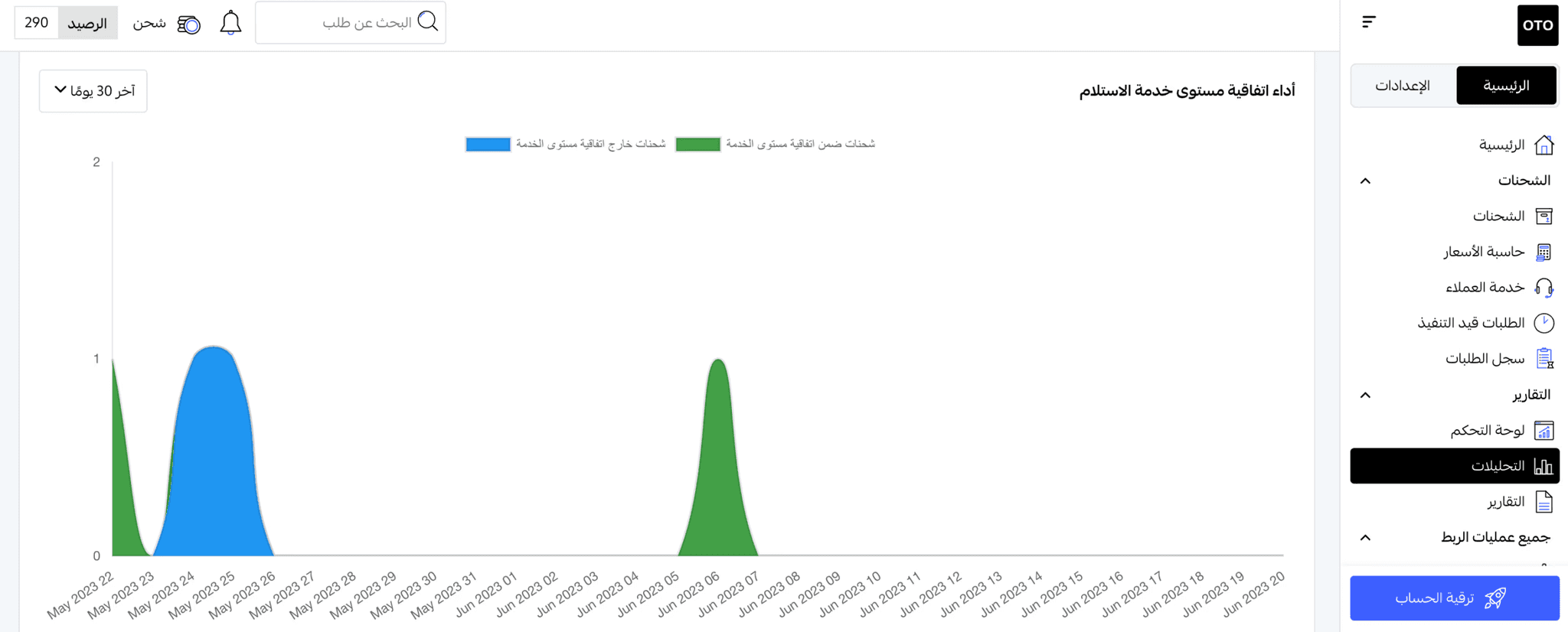
This is the case at Oto. Before you is an illustrative picture from the Oto shipping gateway control panel for Service Level Agreements analyses between the customer and the shipping company 👇
As shown before you, you can view reports up to 30 days, or specify another time range for more than 30 days.
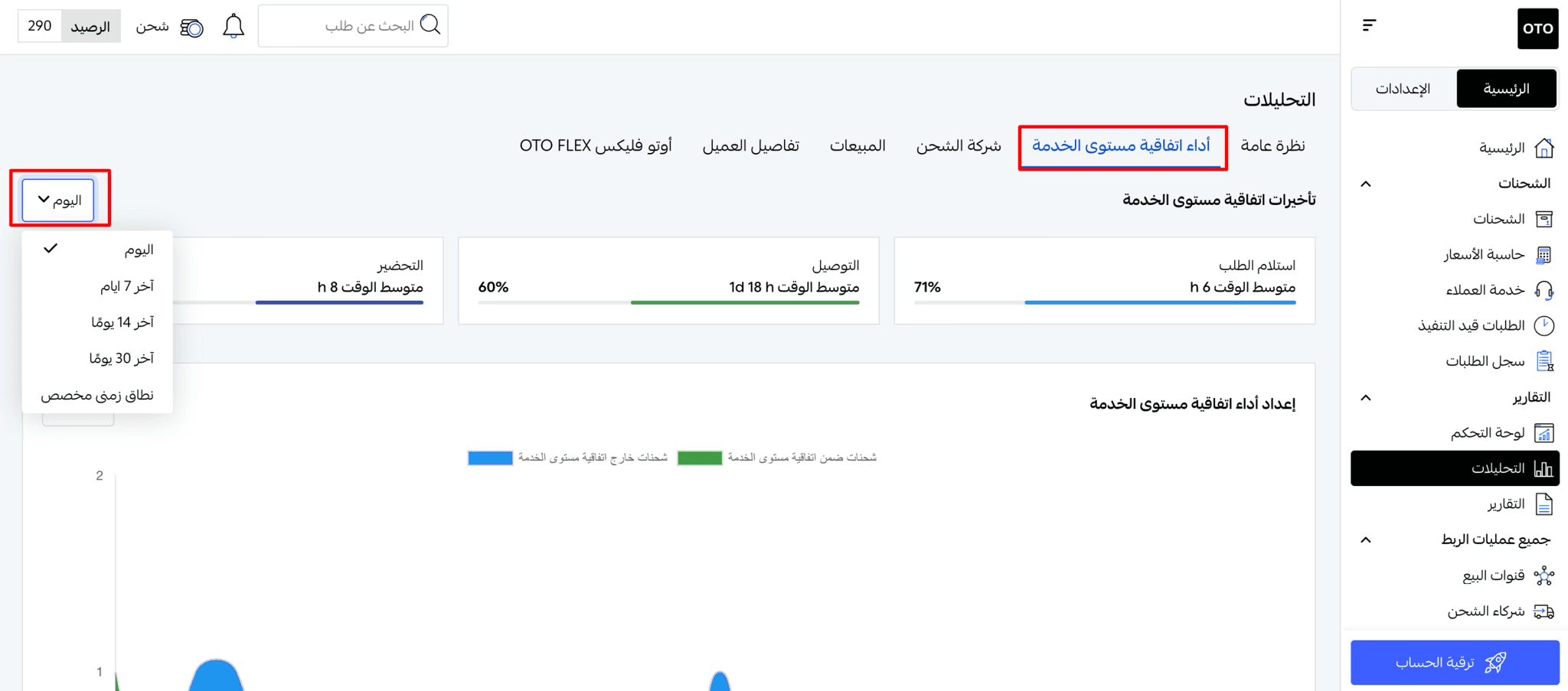
Several points are displayed on this dashboard, such as the average order reception, the average time period for order delivery, and also the average order preparation period.
Thus, as a merchant and brand owner, you succeed in easily tracking the performance of the shipping company you contract with.
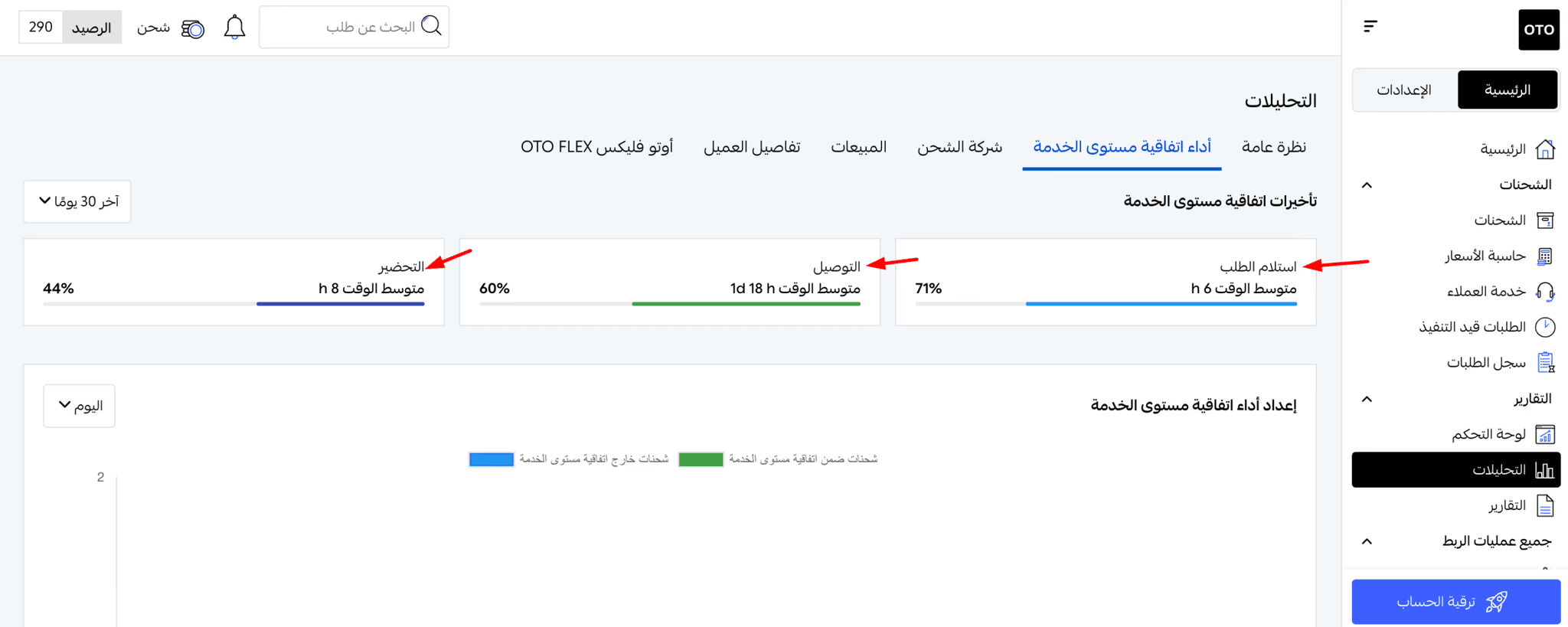
Here is another example of Service Level Agreement (SLA) performance analytics and how to view and track them via the Oto platform through your private account, such as the performance of the Pickup Service Level Agreement.
Improving Service Quality and Performance
The existence of a Service Level Agreement between the customer and the service provider helps each of them define, track, and evaluate performance standards periodically. This helps them continuously identify weaknesses and strengths, enabling each of them to improve what they offer or their performance, which reflects positively on their work and improvement.
The 7 Elements of a Service Level Agreement
The content of the Service Level Agreement includes several key elements:
1. Service description
A precise list of what the provider delivers: shipping and delivery, warehousing, packaging, coverage area, and pickup/receiving services.
For example:
Shipping and delivery services.
Storage services.
Packaging services.
Service distribution scope.
Goods receipt services.
2. Defining Performance Standards
The metrics that will be tracked: average delivery time, on-time rate, shipment-security procedures, support responsiveness, and how loss or damage is handled.
For example, in the logistics field and the agreement between a shipping company and a merchant, these metrics will include:
Average time period for shipment delivery.
Commitment and accuracy in shipment delivery.
Shipment security procedures.
Technical support in normal cases and in emergency situations.
How to deal with loss, damage, and the like.
3. Defining the Responsibilities of the Two Parties
Who owes what service cost, payment terms, packaging obligations, and what the client must provide (accurate addresses, ready-to-ship orders).
4. Defining Communication Methods
The official contact points, escalation paths, and expected response times for each channel.
5. Defining How to Prepare Reports
Report format, frequency, and the metrics included ideally available in real time through a dashboard rather than monthly PDFs.
6. Defining How to Manage Problems
How problems are raised, prioritized, and resolved, including emergency contacts and escalation timelines.
7. Conditions for Renewal or Termination of the Agreement
When and how the agreement is reviewed, renewed, or terminated, and any penalties or notice periods that apply.
Therefore, it is necessary to include these rules in the agreement and how they can proceed, whether for renewal and what are the conditions for renewal or termination, and whether there are penalty clauses or the like.
Key Performance Metrics for Service Level Agreement

There are many Service Level Agreement performance metrics that must be relied upon to measure performance, including:
Response Time
Aims to measure the duration it takes the service provider to respond to the customer's request or begin dealing with the problem. For example, if a customer submits an inquiry or reports a problem, the SLA defines the maximum time the provider should take to respond, such as "respond within 2 hours."
Resolution Time
Refers to the time required to solve the problem or complete the request after receiving it. This metric helps ensure the speed and efficiency of the service, such as setting that technical fault repair must be done within 24 hours of reporting it.
Uptime Percentage
Expresses the percentage of time the service is available to customers without interruption.
First Call Resolution (FCR)
Is responsible for measuring the percentage of problems or inquiries that are resolved on the first contact without the need for additional follow-up. The higher this rate, the greater customer satisfaction and the lower operational costs.
Delivery Accuracy
In shipping and delivery services, this metric measures the percentage of orders delivered on time without errors.
Error Rate
Is responsible for measuring the number of errors or problems that occur during service delivery, such as orders that were not processed correctly or technical issues faced by customers. This metric helps improve service quality and reduce future errors.
Customer Satisfaction Score (CSAT)
Is usually measured through customer surveys that reflect their level of satisfaction with the provided service. This metric allows the service provider to evaluate its performance and work to improve the customer experience.
SLA Compliance Rate
Measures the extent of the service provider's commitment to the terms of the agreement, such as the percentage of requests or problems handled within the specified time frame. A high rate means that the service is operating efficiently and conforming to the agreed-upon expectations.
Service Downtime Frequency
Defines the number of times the service breaks down during a specific period. If the number of outages increases, it may be an indication of the need to improve infrastructure or update operating processes.
Considerations for Selecting Service Level Agreement Performance Metrics
When selecting Service Level Agreement performance metrics, it is important to ensure that they accurately reflect service quality and help improve performance and meet customer expectations. Choosing the wrong metrics may lead to an unrealistic measure of performance or focus on aspects that do not affect customer satisfaction.
The following are the most important considerations that must be taken into account when choosing performance metrics:
Alignment of Metrics with Business Objectives
It should be noted that the selected metrics are consistent with the general goals of the institution. They must reflect fundamental priorities and support the achievement of operational and strategic success. Metrics that do not serve organizational goals may lead to unhelpful results or unfocused efforts.
Measurability and Traceability
Performance metrics must be accurately measurable using clear tools, as this helps ensure the possibility of tracking progress and continuous improvement. Metrics that are not measurable or rely on inaccurate estimates may lead to wrong decisions as a result of being based on untrue data.
Direct Link to Customer Experience
Performance metrics must be directly relevant to the quality of service customers receive, as this helps improve customer satisfaction and increase their loyalty. Metrics that focus only on internal operations without considering the end-user experience may not reflect the company's true performance.
Achieving Balance between Efficiency and Quality
Metrics should be chosen that contribute to achieving a balance between improving operational efficiency and ensuring service quality. Some metrics may focus only on speed without paying attention to quality, which may lead to providing an unsatisfactory service despite the efficiency of operations.
For example, if the Service Level Agreement (SLA) only measures the "initial response time" in the technical support center without looking at the "first call resolution rate," the response may be fast but without an effective solution, which negatively affects customer satisfaction.
Clarity and Ease of Understanding
Metrics must be clear and easy to understand for both the service provider and customers, as this ensures transparency in performance evaluation and reduces disputes over the interpretation of results. Complex metrics or those that contain unclear terms may lead to misunderstanding and affect trust between the contracting parties.
Verifiability and Auditing Capability
Performance metrics should be verifiable and auditable by all concerned parties, which helps build trust and ensures that there is no manipulation of data, which necessitates the availability of technical means or periodic reports through which the accuracy of measurement can be confirmed.
Flexibility and Adaptability
Performance metrics must be adjustable over time to keep pace with changes in customer needs and the operating environment. Relying on fixed metrics without updating them may render them ineffective or inappropriate with changes in the market and technologies.
Compliance with Regulations and Policies
In some industries, SLA performance metrics must comply with applicable legal regulations and policies, as this ensures legal compliance and spares the institution potential penalties.
When should the Service Level Agreement be reviewed?
In the following cases:
Change in customer requirements or business needs: As companies grow and customer needs change, the terms of the agreement may become inconsistent with current expectations, which necessitates modifying them to ensure continued customer satisfaction and improve the service experience.
Developments in operational processes or technology: Technology updates or process improvements may lead to a change in performance level or the provision of faster services, which requires modifying the SLA to comply with new capabilities and improve efficiency.
Increase in the rate of complaints or non-compliance with standards: If complaints increase or reports show a failure to meet the specified standards, it is necessary to review the agreement to ensure the service provider is committed to improving their performance and reducing operational problems.
Market expansion or introduction of new services: When entering new markets or adding new services, requirements and regulations may differ, which necessitates modifying the agreement to cover the changes and ensure compliance with local laws.
Expiry of the agreement period or upon renewal: The agreement must be reviewed before renewal to ensure that it is still appropriate and aligned with the new goals, which prevents the continuation of ineffective or non-compliant clauses with the current situation.
Legal or regulatory changes: In some sectors, regulatory bodies may impose new laws that require modifications to service standards to ensure legal compliance and avoid risks and penalties.
Changes in agreements of suppliers or external partners: If the suppliers or partners on whom the service provider relies are changed, this may affect the service level, which requires reviewing the SLA to ensure continued consistency and quality.
Improving market competitiveness: If competing companies offer better or faster services, the institution may need to modify the SLA to improve the service level, maintain its competitiveness, and attract more customers.
Periodic evaluation and performance analysis: Even in the absence of clear problems, it is preferable to conduct a periodic review of the SLA using performance data and measuring customer satisfaction to ensure that it is still appropriate and effective.
Frequently Asked Questions
What does SLA stand for?
SLA stands for Service Level Agreement, a contract defining the service standards a provider commits to and the remedies when they are missed.
What is the difference between an SLA and a KPI?
The SLA is the agreement; KPIs are the metrics inside it used to measure whether the agreement is being met. An SLA without KPIs is unenforceable; KPIs without an SLA carry no consequences.
What happens if an SLA is breached?
The agreement defines the remedy, usually service credits, compensation for lost or damaged shipments, or termination rights after repeated breaches.
How do I track courier SLAs across multiple shipping companies?
Use a shipping management platform. OTO connects your store to 200+ carriers and tracks delivery performance per carrier in one dashboard, so you can compare real SLA performance and route orders to the best performer.
In Conclusion,
An SLA turns service quality from a hope into a managed number. Define the services precisely, agree on a short list of KPIs with real benchmarks, review the data quarterly, and hold your logistics partners to it. Merchants who do this consistently ship faster, lose fewer orders, and keep more customers.
Ready to see how your shipping companies actually perform? Create your free OTO account and track SLA analytics across every carrier from a single dashboard.

Eman Ragaa