Saudi Arabia’s freight and logistics market is worth roughly USD 28.7 billion in 2026 and is on track to reach USD 37.8 billion by 2031, while Vision 2030 pushes the sector toward 10% of GDP. Growth at this pace cannot be managed on spreadsheets. This guide explains what a logistics management system is, the capabilities that matter in 2026, and how OTO’s integrated systems cover the full supply chain from order to doorstep to return.
What Is a Logistics Management System?
A logistics management system (LMS) is software that plans, executes, and monitors the movement of goods orders, inventory, shipping, delivery, and returns from a single dashboard. Instead of juggling separate tools and carrier portals, businesses use an LMS to automate order routing, compare and book carriers, track shipments in real time, and analyze performance data to cut costs.
What to Look For in a Logistics System in 2026?
Carrier integrations. The system should connect you to local and international carriers out of the box, not require custom development per courier.
Automation rules. Auto-assign each order to the best carrier by destination, weight, cost, or SLA.
Real-time tracking and notifications. For you and your customers, across every carrier in one view.
Warehouse and fulfillment tools. Picking, packing, and inventory accuracy determine whether delivery promises are kept.
Returns workflow. Returns are now a core customer-experience touchpoint, not an afterthought.
Analytics. Cost auditing, SLA compliance per carrier, and delivery performance dashboards.
Sales-channel integrations. Native connections to Salla, Zid, Shopify, WooCommerce, and ERP systems.
Building Bridges and Changing the Logistics Landscape in the Arab World
Since the launch of OTO, the leading shipping gateway in the Arab world in 2019, it has taken upon itself the mission of changing the landscape of the shipping and logistics sector in the region, in line with Saudi Arabia's Vision 2030, empowering business owners, supporting omnichannel selling strategies, and developing shipping management systems and software and automation for e-commerce to be the pivotal link between different sales channels, warehouses, and point-of-sale (POS) systems.
This is in addition to providing competitive shipping prices, controlling all stages of the supply chain, monitoring them in real time, and providing instant data to make decisions based on data, not assumptions.
OTO combines many innovative systems that help large and small commercial activities alike to manage various logistical operations easily through a simple and easy-to-use control panel to provide a smooth and distinguished shipping experience that contributes to enhancing competitive value.
OTO: An Integrated Logistics Platform for the Arab World
Since launching in 2019, OTO has grown into the leading shipping platform in the Arab world, connecting merchants to 200+ local and international carriers with competitive negotiated rates, end-to-end supply chain visibility, and real-time data for decision-making. Below are the eight systems that make up the platform.
First: Order Management System (OMS)
Manages the full order lifecycle from receipt to fulfillment in one dashboard: customizable order orchestration per business rules, automated processing that removes manual errors, multi-channel order sync (online store, marketplaces, retail), and ERP integration.
Real results: OTO helped Al Saif Gallery absorb a ~10x increase in orders without sacrificing fulfillment speed, and enabled Whites Pharmacy to deliver orders within 2 hours of purchase.
This innovative system from OTO has many features, including:
Customizing the order orchestration process to process them based on the specific needs of each business and ensuring maximum efficiency and professionalism.
For example, OTO contributed to accelerating the order fulfillment process at Al Saif Gallery last year after it increased by about 10 times, thanks to the ease of receiving and processing orders through one control panel, which contributed to enhancing efficiency and growth.

Providing a central control panel to manage orders and monitor performance moment by moment.
Automatically processing orders to reduce delays and manual errors. For example, OTO helped Whites Pharmacy chain deliver orders to customers within two hours of completing the order.
Effectively managing orders across multiple sales channels such as e-commerce stores and traditional stores.
Granting the possibility of integration with different systems such as ERP systems.
This advanced system provides logistics solutions in:
Fast order fulfillment which contributes to gaining customer satisfaction and enhancing their loyalty.
Simplifying the order processing operation faster and error-free.
Facilitating technical integration with different sales channels to synchronize orders and ensure harmonious operational processes.
Second: Warehouse Management System (WMS)
Optimizes warehouse operations: zone-based warehouse organization, faster and more accurate order picking, guided workflows for warehouse staff, and streamlined packing that cuts errors and time. The result is accurate fulfillment, simpler returns handling, and lower operating costs per order.
Dividing the warehouse into several zones and paths to facilitate the process of managing goods from the moment they arrive at the warehouse until they leave.
Improving order picking times whether from branches or dedicated pickup areas.
Improving the efficiency of warehouse workers by providing clear and simple instructions to prepare the required items accurately and with minimal time and effort.
Improving packaging operations and reducing errors and the time required for packaging.
This advanced system from OTO helps commercial activities in:
Fulfilling orders accurately and without errors which leads to improved customer satisfaction.
Simplifying returns management without complexity as a result of organizing the performance of workers within the warehouses.
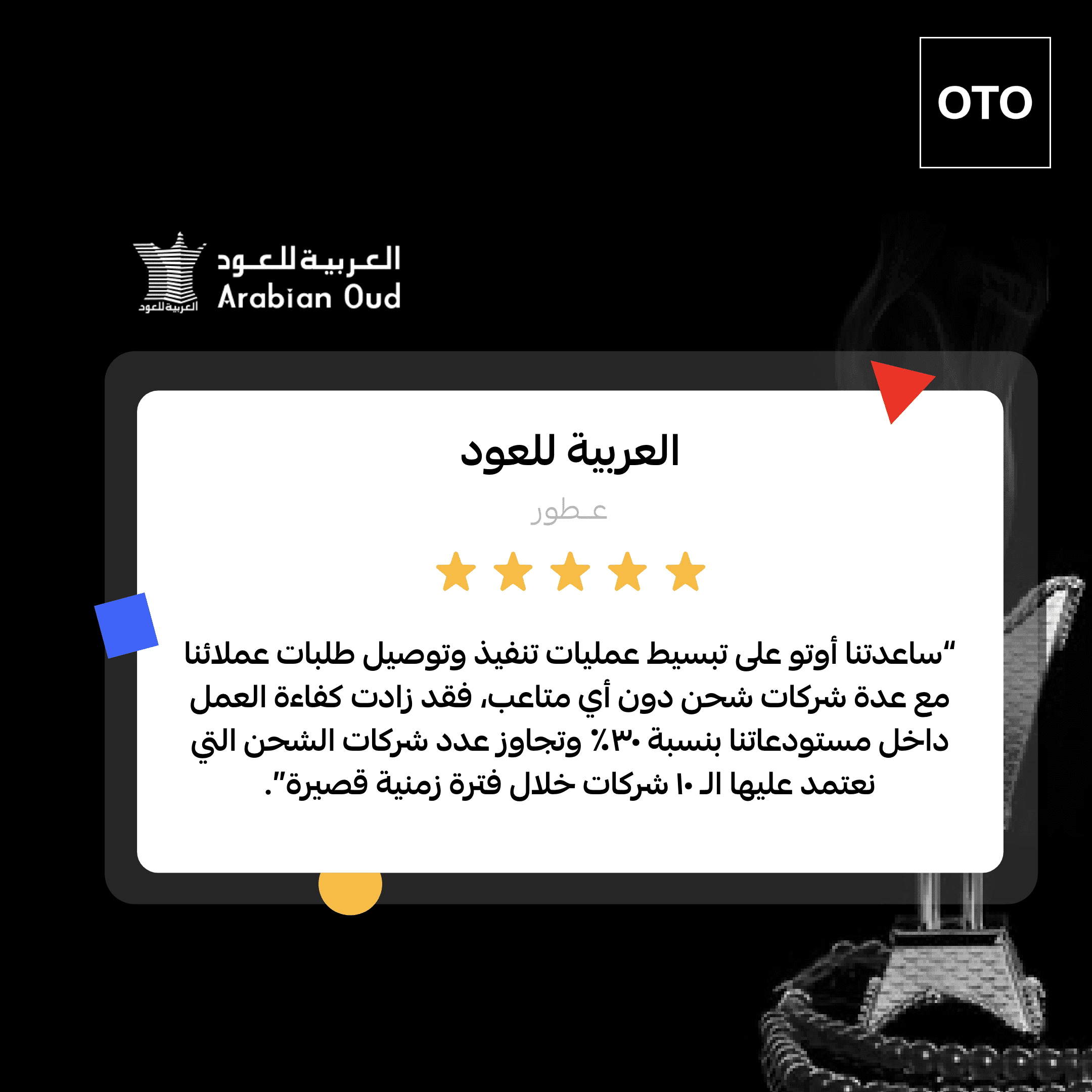
Reducing operating costs within warehouses such as accurately picking product items and effectively packaging them, in addition to reducing labor requirements. For example, OTO's smart and innovative solutions have contributed to increasing work efficiency within Arabian Oud warehouses by 30%.
Third: Logistics Management System (LMS)
Solves the last-mile coordination problem: technical integration with 200+ shipping companies, rule-based automated carrier assignment, real-time shipment tracking for merchants and their customers, and SLA monitoring that holds every carrier accountable for on-time delivery.
For this reason, OTO worked on innovating a unique system that contributes to simplifying the last-mile delivery process by providing strong technical integration with shipping companies supported by an advanced automation system.
Perhaps the most important features of this innovative system from OTO are the following:
Technical Integration: OTO's advanced logistics management system is technically connected to more than 200 local and international shipping and delivery companies, which contributes to simplifying the process of choosing shipping partners for merchants and business owners.
Automated shipping according to customized rules: OTO provides an automation system that automatically executes shipping operations based on many inputs or rules that you set in advance so that the best shipping company is chosen in terms of performance, cost, speed, or other inputs.
Shipment Tracking: OTO allows business owners and their customers to monitor orders step by step in real time, which enhances transparency and reliability and increases the merchant's ability to control shipping operations from start to finish.
Management and Performance Improvement: This system allows companies to manage and ensure adherence to service level agreements for shipping companies, which ensures timely delivery and meeting customer expectations.
The most prominent benefits of the LMS are:
Providing accurate shipment tracking that achieves transparency between the merchant and the customer.
Meeting and even exceeding the service level agreements of shipping companies to ensure timely delivery.
Smooth and simplified technical integration with shipping companies.
Advanced automation system that contributes to accelerating and improving shipping operations.

Fourth: Shipping Aggregators
All carriers in one account: compare prices and services side by side, auto-calculate shipping cost by dimensions, weight, and destination, print labels in bulk across different carriers, and pay OTO’s pre-negotiated discounted rates. Arabian Oud, for example, manages 10+ shipping companies from a single OTO dashboard.
This unique solution from OTO has many important features, including:
Access to a variety of shipping and delivery company services, including major and specialized service providers, all through one comprehensive and smooth control panel.
⭐ For example, OTO helped Arabian Oud connect and deal directly with more than 10 shipping companies without confusion or complexity, and manage them all from one control panel to meet different needs.
Automatically calculating shipping costs taking into account the dimensions, weight, and destination of the shipment so that merchants can compare the prices and features of shipping companies to make accurate decisions and balance cost and delivery speed.
Monitoring performance, updating information, and sending instant notifications directly to customers about the status of their shipments.
Providing the ability for bulk shipping and printing shipping labels all at once to manage multiple shipments through different shipping and delivery companies, with the ability to customize labels and invoices to suit your brand identity.
This innovative system from OTO benefits brands in:
Reducing shipping costs by using OTO's special pre-negotiated reduced rates.
Saving time with automation features that allow processing and fulfilling multiple shipments at the same time through one control panel.
Reducing the volume of manual tasks and thus reducing the likelihood of errors in shipping details or customer data.
Scaling operational processes up or down according to your business activity levels as a result of providing a wide range of services that meet different shipping needs, whether for small merchants with a small number of shipments or for large companies with a huge number of regular shipments.

Fifth: Driver Management System (DMS)
For businesses running their own fleet: dispatch orders to drivers with pickup and delivery routing, assign drivers by coverage zone, set daily capacity and performance targets per driver, and apply internal SLAs to measure driver response and delivery times. The outcome is a higher delivery volume at lower fleet cost, with proof-of-delivery built in.
This system is represented in the OTO FLEX application, which enables:
Sending and receiving orders to drivers and directing them to pickup and delivery locations with ease.
Dividing drivers according to the work area to be covered.
Determining the number of orders that can be picked up and delivered for each driver on a daily or monthly basis to measure the extent to which drivers meet the sent orders and their performance in dealing with them, ensuring the tasks are executed effectively and with high quality.
It is worth noting that you can set a Service Level Agreement (SLA) for your private drivers so that you can measure the extent of their commitment and speed of response to orders. For example, you can set a clause that guarantees fast delivery of orders to customers so that it does not exceed 4 hours, and then you can measure the performance of each driver separately and identify the problem causing the delay in order delivery.
In short, it can be said that the Driver Management System provided by OTO, the leading shipping gateway in the Arab world, and represented in the OTO FLEX application, gives owners of large commercial activities the ability to deal with their private drivers as if they were an independent shipping company whose performance can be monitored and measured through key performance indicators according to the pre-established service level agreement, ensuring the fastest possible delivery of orders to consumers.
The OTO FLEX application has many features, including:
Improving scheduling and planning: OTO's driver management system provides detailed information about driver locations and their working hours. This information can be used to improve order scheduling operations, determine the most effective routes, and determine optimal delivery times. In addition, detailed information can be provided to customers about the delivery status and potential delays.
Reducing costs and increasing productivity: Thanks to improved efficiency and planning, the driver management system can contribute to reducing the overall costs of the commercial activity's fleet and improving productivity by reducing unjustified vehicle stops and avoiding congested roads, thus delivering orders to customers as quickly as possible.
Improving driver performance: The driver management system provided by OTO helps monitor and evaluate driver performance by analyzing data to identify weaknesses, work to improve them, and provide appropriate training to enhance efficiency.
The most prominent benefits of this system are:
Managing drivers and operational processes, monitoring performance, discovering opportunities, and supporting decision-making based on data, not assumptions.
Enhancing the company's reputation and customer satisfaction level by providing direct shipment tracking mechanisms, adhering to expected delivery times accurately, and providing ways to prove that orders have been sent and received by customers.
Handling a larger volume of delivery operations, reducing operating costs, and providing the necessary flexibility to accept last-minute changes smoothly.
Sixth: Returns Management System (RMS)
Turns returns from a cost center into a retention tool: customers submit returns through a branded self-service form, multiple items per return request, automatic return-label creation with any connected carrier, instant status notifications, and analytics on return reasons to fix root causes. Faster inspection and restocking means less capital sitting in limbo.
OTO's Returns Management System provides an innovative solution for large commercial activities. Through it, returned orders can be easily controlled, and a return form can be sent to the customer that simplifies the steps for returning products so that they can log in, view all the orders they purchased, choose the product to be returned, state the reason for returning the product, attach the receipt as evidence, and then verify and process the request and retrieve it with ease.
This contributes to eliminating traditional methods that consumed time and effort from the customer as well as the commercial activity to retrieve products.
It is worth noting that OTO, the leading shipping gateway in the Arab world, provides a smooth and distinguished control panel for owners of large commercial activities to manage returns, view all returned orders, and deal with them according to the set policies.
Once the return request is approved, a return shipment can be created with any of the available shipping companies, as OTO undertakes to issue the return label and send it to the customer to place it on their package so that the shipping company can come to pick up the shipment as quickly as possible.
The most prominent features of OTO's Returns Management System are:
Granting the necessary flexibility to customers to be able to return more than one product in one request.
Effectively processing return requests, inspecting returned items, and quickly restocking them; to avoid waste and loss of funds.
The ability to send instant notifications to customers to track the status of their return request
Building a clear vision and in-depth understanding of the reasons for return; to apply future improvements to products or different shopping aspects.
This system has multiple benefits, the most important of which are:
Increasing customer trust by providing a smooth and fast return service without complications.
Reducing costs by processing returns and managing inventory faster.
Discovering opportunities and extracting actionable procedures to improve products and enhance the performance of operational processes.

Seventh: Notifications and Alerts System (CNS)
Automated SMS, email, and WhatsApp updates at every shipment stage, branded tracking pages, and personalized messages. Customers stop calling support to ask "where is my order"; support teams reclaim their time, and delivery failure rates drop because customers know when to expect the courier.
OTO's Notification Management System is an integrated system that allows sending text messages, email, or WhatsApp messages with the aim of tracking shipments and knowing their delivery times to avoid delivery failure. OTO's Notifications and Alerts System has many features, including:
Simplifying and organizing the process of sending notifications and alerts to customers about the status of their shipments to monitor them in real time and know delivery times.
Sending automatic instant notifications to customers to verify order data, or inform them of shipment status updates, or changes to the shipping service, and others, thereby achieving accurate and effective communication with them, which enhances transparency and reliability.
Creating tracking pages with a distinctive brand identity, as well as customizing tracking messages with customer names, referring to their purchases, or mentioning information specific to their location, etc.
The benefits of this system include:
Enhancing satisfaction and loyalty levels by keeping customers informed of every stage of their shipment journey.
Increasing operational efficiency and reducing the workload on customer service teams – by using instant automatic notifications sent to customers – to give them time to focus on more important and complex tasks.
Enhancing customer interaction and engagement with commercial activities through regular and relevant communication that establishes your brand in the customer's mind.
Eighth: Business Intelligence and Analytics System
Dashboards updated in real time: shipping performance by carrier, automatic cost auditing that compares carrier invoices against contracted rates, and operational KPIs that surface problems before customers feel them. Decisions get made on data, not assumptions.
OTO's Business Intelligence and Analytics system supports strategies based on accurate data and actionable insights to contribute to improving the decision-making process at the optimal time. This system has many features, the most prominent of which are:
Evaluating performance by analyzing shipping data and operational processes.
Automatically evaluating shipping costs to compare shipping invoices with estimated shipping contract prices.
Dashboards that are updated instantly to display key performance metrics.
This advanced system is beneficial in:
Making informed strategic decisions supported by clear and comprehensive data at your fingertips.
Increasing the efficiency of the business as a whole by addressing challenges related to operational processes, shortcomings, and any other issues.
Benefiting from instant analytics to gain a competitive advantage as a result of understanding market trends, customer behavior, available opportunities, and potential risks.
This is a quick overview of the most important aspects of OTO's logistics systems, and here are some tips for making full use of these systems for your commercial activity.
How to Get the Most Out of a Logistics Management System
Use the analytics weekly: review cost per shipment and on-time rate per carrier, and shift volume to the best performers.
Set automation rules once; then refine monthly destination-based carrier assignment alone saves hours per day.
Offer customers multiple delivery options (express, same-day, refrigerated, international); the carrier network makes this free to enable.
Turn on proactive notifications to cut "where is my order" tickets and failed deliveries.
Audit carrier invoices automatically against contracted rates; billing discrepancies are common and recoverable.
Frequently Asked Questions
What is the difference between an LMS and a TMS?
A transportation management system (TMS) focuses on planning and executing freight movement. A logistics management system is broader; it covers orders, warehousing, last-mile delivery, returns, and analytics. For e-commerce businesses, an integrated platform like OTO effectively combines both.
Do small businesses need a logistics management system?
Yes, arguably more than large ones. Small merchants cannot negotiate carrier discounts alone or build integrations; a platform gives them enterprise-grade rates and automation from the first order.
Which logistics system works with Salla and Zid?
OTO integrates natively with the region’s major e-commerce platforms including Salla and Zid, as well as Shopify and WooCommerce, syncing orders automatically for fulfillment and shipping.
In Conclusion
The winners in Arab e-commerce logistics are the businesses that run their supply chain on data: automated order routing, accountable carriers, visible inventory, and painless returns. OTO brings all of it into one platform connected to 200+ carriers.
Create a free OTO account, connect your store, and see the difference in your first week of shipments.

إيهاب محمود